The most useful item on any search is attention. Everything in your bag should support it.
New explorers often buy gadgets before they have learned what actually slows them down. Resist that impulse. Go out three or four times with a minimal kit and keep a short note of what you missed: a dry pen, gloves, a better light. Then add exactly that. A light bag lets you move quietly, stay longer and look less conspicuous in a town square, all of which lead to better finds.
This list is organised by job rather than by brand. Where we name products, such as Garmin’s eTrex and GPSMAP ranges or baseplate compasses from Silva and Suunto, it is to show the type of tool, not to endorse a purchase. We are not paid by any manufacturer.
Positioning and navigation
▯
Smartphone with offline mapsFine for most urban and park searches. Download the area in advance and switch on airplane mode with location enabled to save battery in weak-signal zones.
⌖
Handheld GPS receiverWorth considering for long woodland or upland days. Dedicated units such as the Garmin eTrex 32x or GPSMAP 66 series use replaceable AA batteries, work with gloves and survive rain better than most phones.
◈
Baseplate compassA simple, liquid-filled compass with a ruler edge for working with paper maps. It never needs charging.
▦
Paper mapA 1:25,000 sheet for countryside routes shows walls, paths and boundaries that keep you on legal ground.
Logging and caring for containers
Many caches are small and worn by weather. A seeker who leaves a container better than they found it is welcomed by every owner.
✎
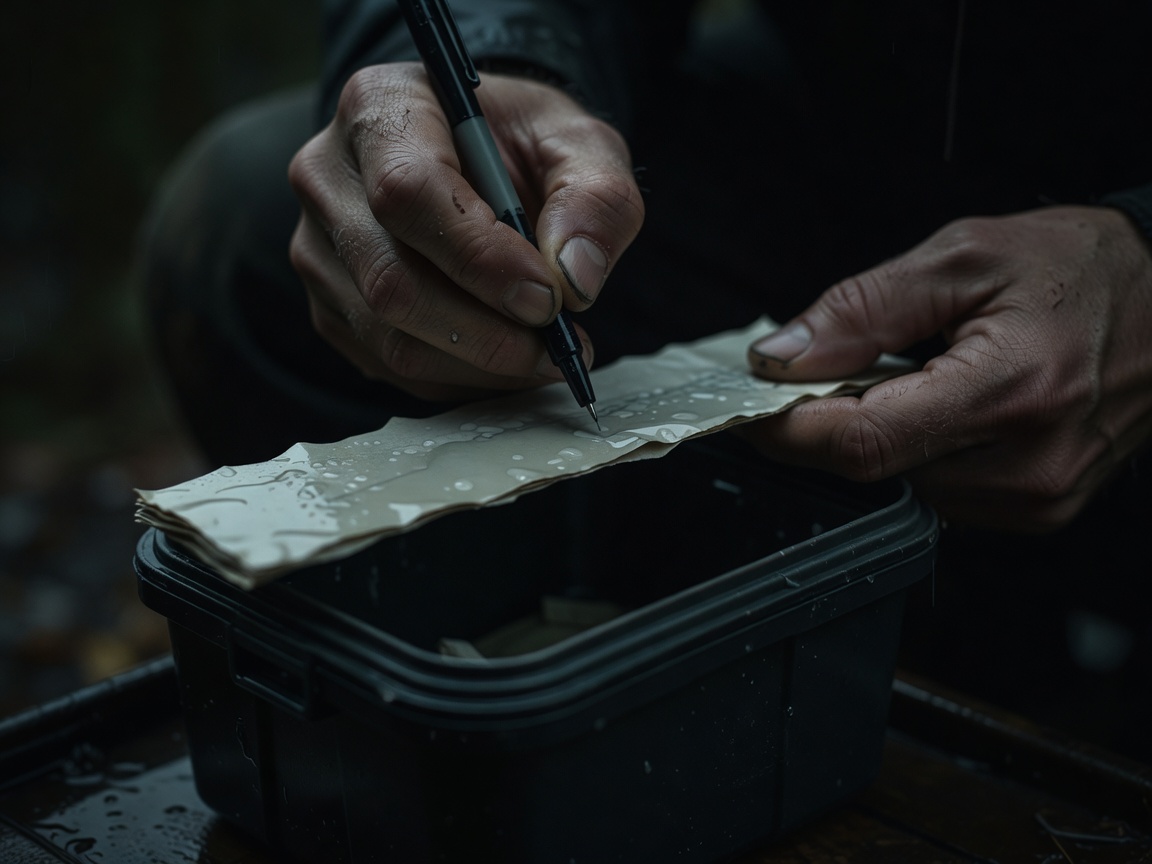
Two pensOne ballpoint and one pencil; pencils still write on damp paper.
▭
Spare log stripsAdd one only if the log is full or soaked, and mention it in your online log.
◫
Small zip bagsFor replacing a split bag around a log sheet.
☐
Trackables and swapsIf you take an item, leave something of equal or greater value. Never leave food, scented items or anything sharp.
Safety and comfort
✚
Compact first-aid kitPlasters, antiseptic wipes, blister dressings and a tick remover for grassland and woodland.
☼
Head torchUseful under bridges and in dense cover even in daylight, and essential if a walk runs late.
⚡
Power bank and cableNavigation apps drain batteries quickly, especially in cold weather.
≈
Water and a layerWeather changes faster than plans. A light waterproof shell covers most surprises.
✋
Thin glovesProtect hands from nettles, brambles and grime without hiding the feel of a container.
♻
Litter bagFor Cache In, Trash Out: carry out what others left behind.
What to leave at home
Some tools appear in hobby forums but cause more harm than good. Leave behind anything designed to dig, cut, lever or climb. Containers on listing sites must not be buried, and no legitimate hide requires removing stones from walls, stripping bark or opening utility covers. A telescopic grabber or inspection mirror can save you from reaching into nettles, but never use them to probe vents, drains or electrical boxes.
Avoid drones near other people or nature reserves, and check national rules before flying anywhere. Metal detectors are a separate hobby with their own permissions, and using one on a scheduled monument in the UK is a criminal offence.
Seasonal adjustments
Spring: insect repellent and extra care around nesting birds. Summer: sun cover and more water. Autumn: a brighter torch for shorter days. Winter: spare batteries kept warm in an inside pocket, and traction for icy paths.